
We are excited to announce the Contributor Support Programme. This programme offers postmarketOS contributors with a high time-commitment the option to receive financial compensation for the work they do. It is designed to achieve the following goals:
- Address some of the sustainability challenges facing postmarketOS development. While we can oftentimes fund feature development through donations (e.g. wireplumber and callaudiod) or grants, other work like essential maintenance, support, and administrative tasks remains difficult to get funded with our current approaches. Some people have already been working on these topics full-time or part-time with no compensation.
- Ensure fairness and equality among participants and their contributions. Everybody is entitled to the same hourly compensation, regardless of location, kind of tasks, or any other variables.
- Fulfill our commitment to supporters who have donated specifically to compensate contributors, as stated on our Open Collective page.
- Establish metrics that strengthen future funding applications by demonstrating our current resource investment, and our ability to distribute funds fairly and efficiently.
High level overview
Every quarter, eligible contributors can opt in for the programme. The total amount of funds available is taken from excess donation income, while making sure that other budgeted items are not affected. Then, every month, contributors invoice proportionally to the hours they work, and report on the tasks that they spend time based on the logged hours. If you want to read more details about criteria, processes, and reasons, you can check the documentation.
We see this as another small step towards improving the project and fulfilling the long-term goals!
Monthly report November 2025
And as we started working on this programme in November, we are now able to provide our first report! During this last month:
- Stefan spent a lot of time looking at pmbootstrap, the tool we use for development. He opened more than 20 Merge Requests, and reviewed a great amount of other people's work too. Stefan also worked on the dint tool, that allows to improve the consistency of our device ports, and to have better documentation. He also improved the programme documentation, attended a meeting to improve Phosh in postmarketOS, and spent a lot of time reviewing other people's work in pmaports.
- Clayton reviewed and approved merge requests across postmarketOS repositories including kernel upgrades for multiple platforms, device support, system infrastructure changes, and organization governance. Completed development of kernel config generation from fragments feature for pmbootstrap (!2625), continued to maintain personal devices, and implemented image building/deploying for the Duranium immutable pmOS project. He also represented postmarketOS at the SeaGL 2025 conference in Seattle by staffing the project booth.
- Pablo spent a majority of his time on governance work. Part of that included CoC work, discussions about possible vendor agreements, the creation of a legal entity, and the management of the legal agreement for the FLOSS Fund grant we received this year. Other work included upstream work in Alpine related to the /usr merge, discussions to follow-up on the callaudiod project, general documentation improvements and some work on PMCRs.
You can find a break-down of detailed information in the exported CSVs in the repository.
Financial update
In order to boot up this programme, we have put a considerable amount of work into financial automation and transparency. You can find all the work done in here. Most remarkably so far:
- The budget and its categories are better documented and easier to find, instead of being only available in blog posts and internal documents. In addition, the expense tags in OpenCollective have been modified to match the budget entries. We are still investigating better ways to address the need for communicating expenses clearly, and having automated accounting. Therefore, some changes to the tags can be expected. If you have thoughts, ideas welcome!
- There is now an automated pipeline to extract information from the OpenCollective API and generate statistics and graphs based on the latest data. Our hope is that these graphs are more educational than lists of bullet points with numbers.
Overview
First, let's compare income and expenses across financial year 2024 and what we have of 2025:
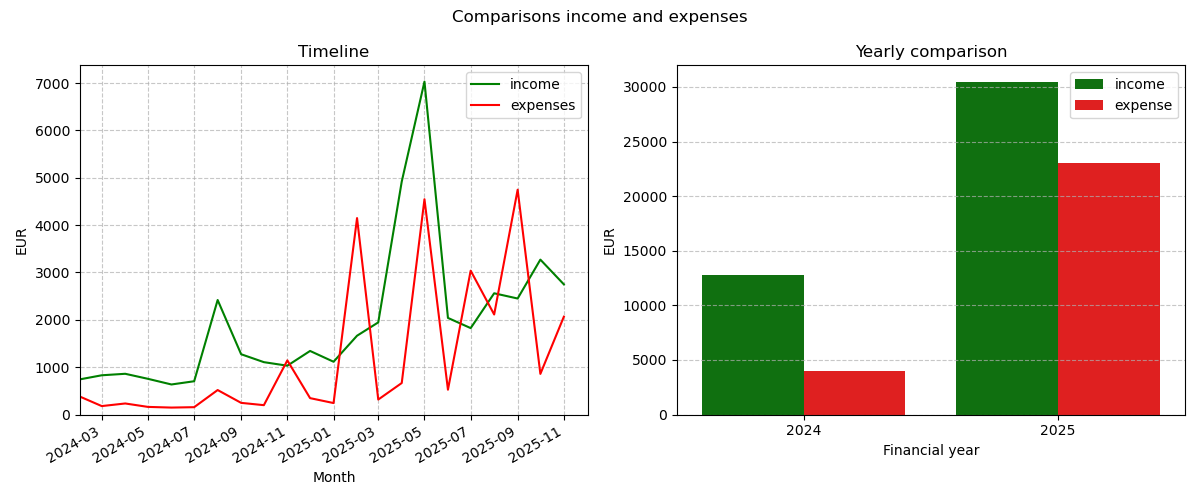
Here we can see that:
- Expenses are very spiky, and often below the income. The programme presented above should help raise the expense baseline and get both lines closer together.
- We have scaled-up the expenses. In 10 months we've spent 5 times as much money as in the previous year. And this is considering that a big chuck of the 2024 expenses were just fiscal host and transfer fees. This is an achieved goal for us. We wanted to spent a lot more money this year on things that improve the health of the project and move us towards our long term goals (see planned budget, callaudiod, hardware testing automation).
- The income has also scaled up, even at a slower rate than expenses, with projections to double or triple last year's income. This shows what an amazing community we have, who value our work and want us to drive linux mobile development forward. If you have been donating to us recently, thank you so much for making this possible!
Income
Now that we've covered a general overview of our finances, let's dig a bit deeper into the income. First we'll focus on the recurrent income, which is what sustains our operations and provides long-term sustainability:
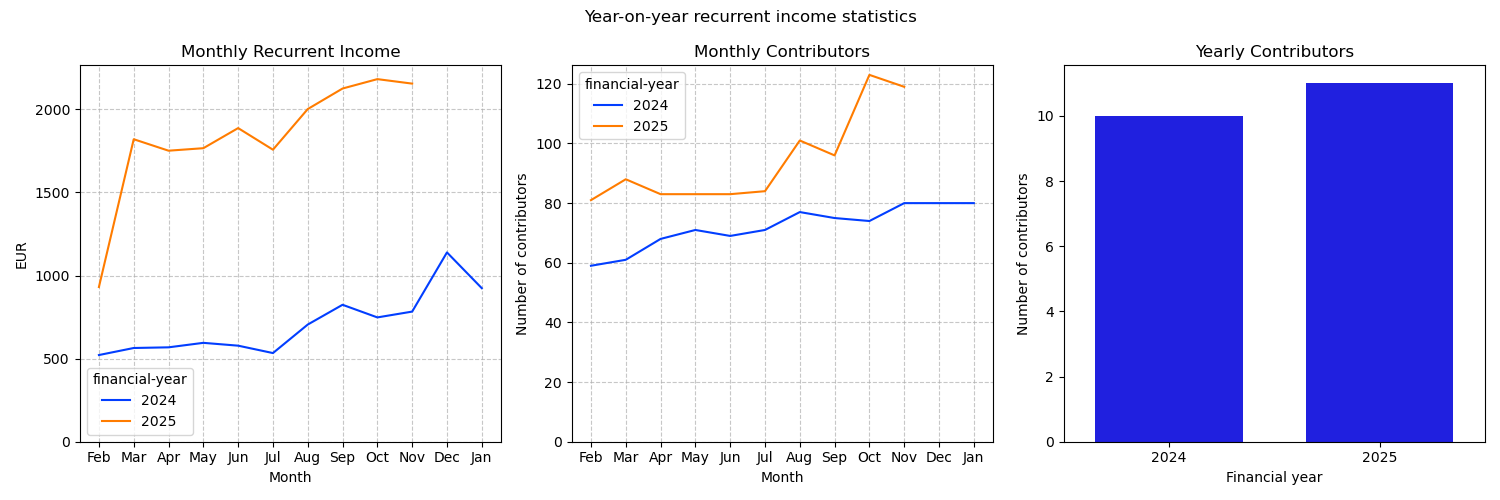
Here we can observe that contribution income has increased more than the number of individual contributions. Few contributors make up a big part of our income. This is a risk we have to consider when making decisions. Otherwise the same pattern with a remarkable growth in income compared to last year is also visible in the recurrent income, which is very positive!
Budget
Finally, let's also look more into the budget. Total numbers for income and expenses are interesting, but a comparison to the budget puts those numbers in context. Note that for the 2025 fiscal year, the budget bars are for the whole year, but the execution bars only have the data until the end of November.
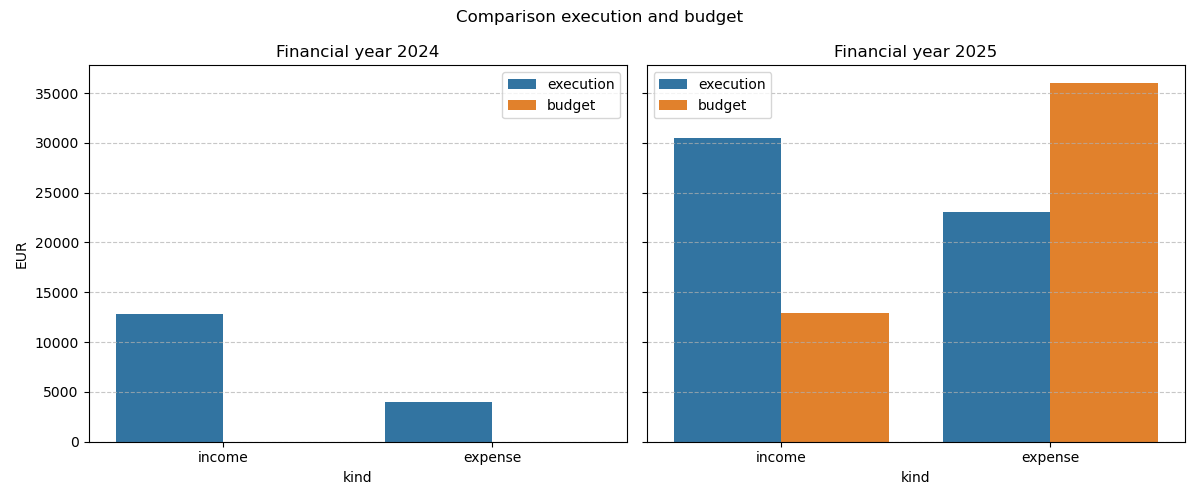
The highlights here:
- 2024 had no budget, so the lines are missing!
- We budgeted a very conservative income without growth, which has not been the case at all. This is something we have to review for the next year. The closer we get to "guessing" our real income, the better we can do financial planning.
- We are going to have a bit of a hard time to execute the completeness of the budget expenses. Although this is not ideal, there are a few reasons for it:
- We amended the budget expenses twice through the year, adding a total of 7800€, to be able to spend some of the excess income. Executing mid-year is surely harder than if planned from the beginning.
- We had a project where we expected a contractor to work for around 10000€ but unfortunately they could not finish the project, and what was started was neither finished nor billed.
- Even though it seems we will not be able to run a deficit, we are going to spend a lot more than we budgeted as income. While our accounting goal was to spend exactly the budgeted amount, the extra income let us invest in project improvements that did more for us than sticking to the original spending target would have.
Are you good with finances? Or graphs?
This is only the start of a more reproducible, and graph-oriented financial reporting. If you have suggestions on how we could modify the graphs or the reporting, feel free to provide feedback on Mastodon or opening an issue. There are some ideas that were brought up already, like showing reserves and expenses in a timeline, so make sure to first check current issues. Any help actually implementing those is of course greatly appreciated as well!
Finally, if you are versed or have an interest in accounting and financial matters, and would like to help us improve anything related to our financial processes or reporting, do not hesitate to get in touch by emailing us at or reaching out on Mastodon. We would really appreciate time and expertise with anybody with either skills or willingness to dive into numbers! 🤿
If you appreciate our financial transparency and appreciate the work we're doing with postmarketOS, you can support us by contributing financially via OpenCollective.