
At the end of January, the 2025 financial year for postmarketOS came to its end, and soon afterwards the budget for the 2026 financial year got approved. Therefore, it is time for a new financial update! This blog post is split into a look at the 2025 budget (plan vs. execution), and further below the budget for 2026, of which the most exciting part is probably the q6voice rework and upstreaming which will improve audio significantly for postmarketOS and other Linux Mobile distributions on a large number of QC devices. Thanks to everybody who has donated to postmarketOS to make this possible!
2025 financial year report
During the 2025 financial year we have put a lot of work and emphasis on financial automation, which lead to a previous report mid-year. However, as our income and expenses have continued growing, the complexity of the operations have too. In consequence, just tracking the money in and money out of our Open Collective account is no longer enough to represent our financial situation. For example, if a certain task has been commissioned to happen in 2025, but for whatever reasons the invoice only arrived in 2026, there needs to be a way to keep track of that. The standard way to do so is by using double-entry bookkeeping. Luckily, there are a few FOSS tools which allow to still automate most of such setup, and keep things transparent. We have decided on hledger and published our initial journal file with the 2025 financial year data here. We will go through it below.
Budget and results
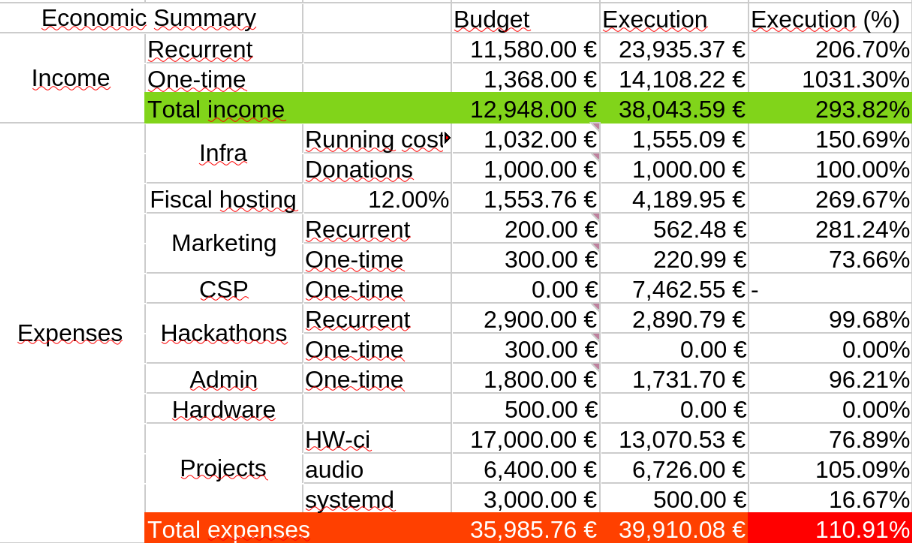
The plan for 2025 was to receive 12948€ in donations income, and have 27785€ as expenses. The idea was to reduce the 47000€ that were laying in our account and put them to good use. Given that through the year we saw a remarkable increase in income, we amended the budget twice, increasing the expenses for a total of 35985€. We did so to be able to execute on the goal of putting money to good use, rather than have it sit in a bank account.
At the end of the year, we received 38038.59€, nearly 3 times more than budgeted, and spent 39908.66€, only slightly above the expectations. Overall, we still managed to run a deficit, even when receiving 3 times more money than initially planned. We consider this a great success, given that our goal was not only to get donations but to put them to good use!
The total amount in OpenCollective at the end of 2025 is 54836.64€ instead of the number we concluded, 45557.99€. This is because we owe different community members a total 9278.65€, mostly on invoices not yet sent or approved:
- Two invoices for the HW-CI had not yet been uploaded to OCE: the first small production run of the PCBs for 1092.41€, and the project management for 428.4€.
- The second part of the callaudiod project for a total of 2200€ has not been billed yet.
- The CSP invoices for January, for a total of 1050.45€ had not yet been billed. And at the same time the accumulated excess income for the last quarter, for which contributors will work during the first quarter of 2026, have of course not been billed either. This goes up to 4477.39€.
You can find more granularity and details on the expenses and execution of each entry of the budget in the above image. We managed to execute pretty successfully on most of the categories with a few exceptions: systemd, where we unable to disburse money to one of the people that did some work and where upstream did most of the work for us; infra, were we had greater costs than anticipated due to our own CI runners; and marketing, where a big order of stickers that is expected to last well into this year increased the costs considerably. This part of the accounting is, however, not yet fully transparent and automated. We aim to get to it for the next financial update.
Financial status
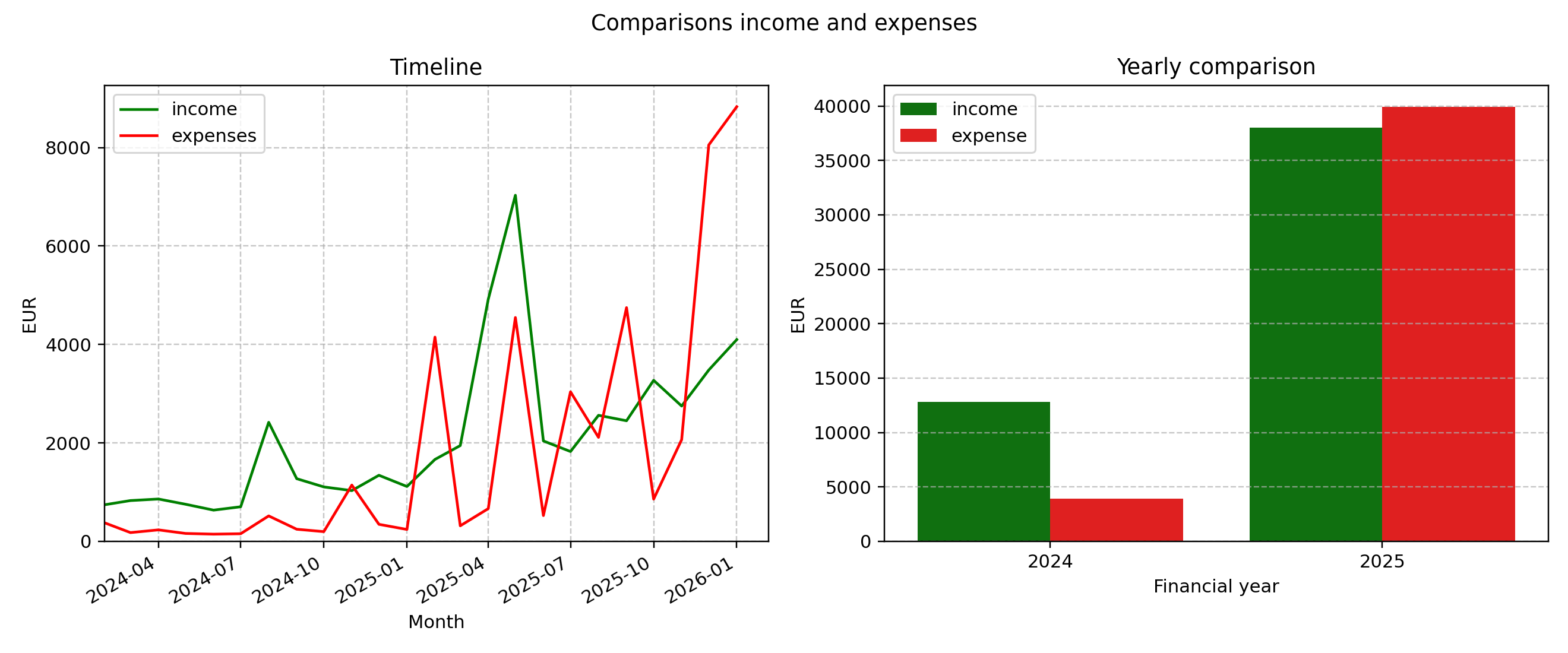
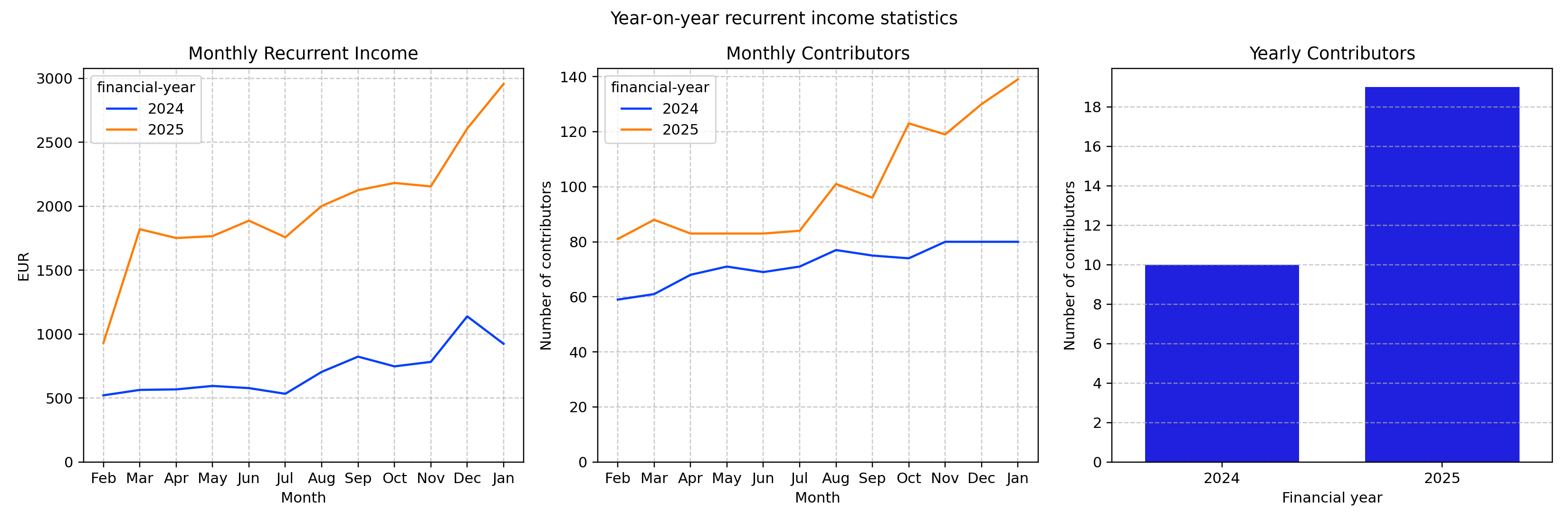
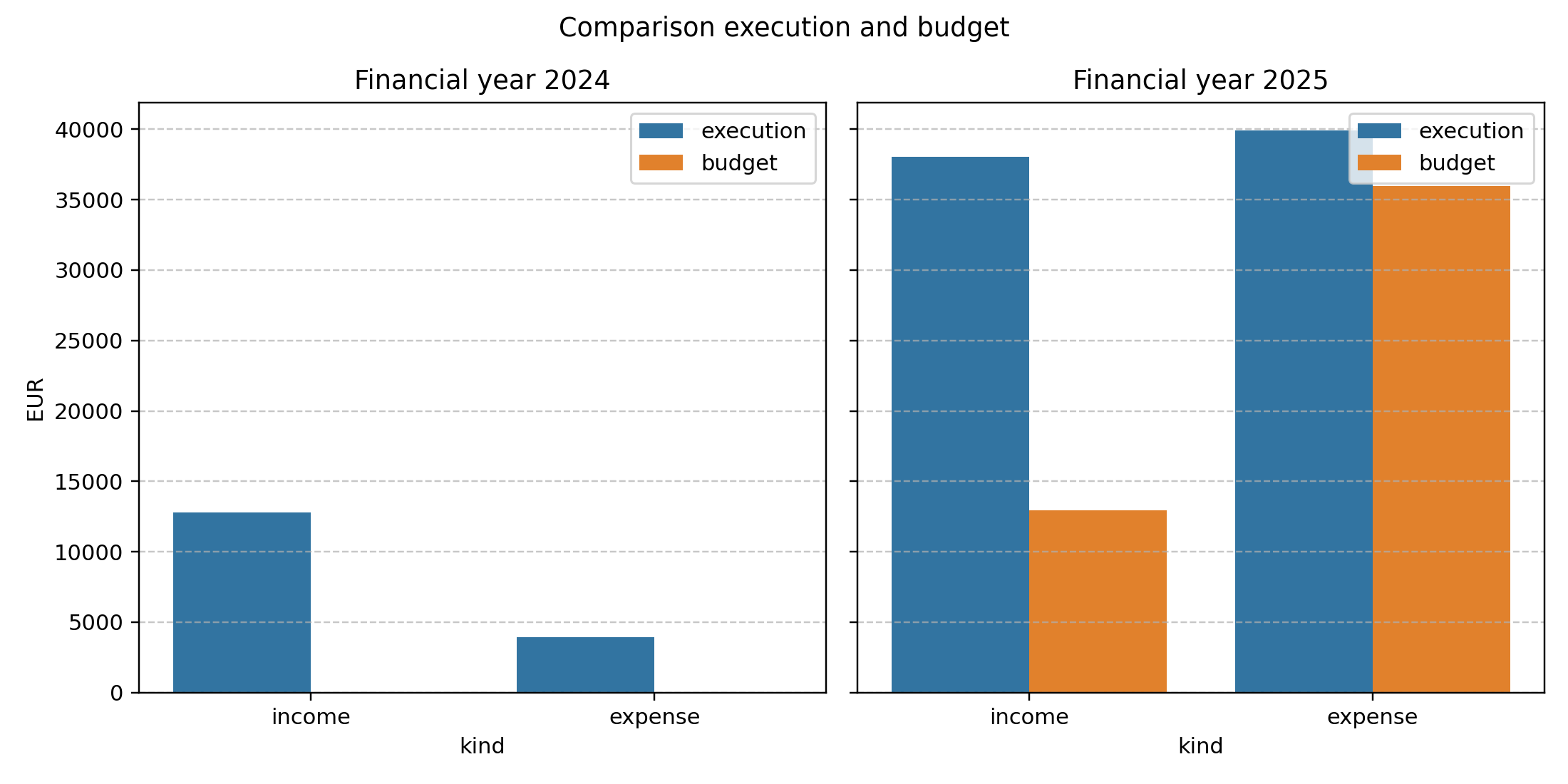
In our latest financial update we provided a detailed analysis of how the 2025 year was developing, and provided some graphs that provided an overview of income and expenses, of the execution compared to the budget, and detailed recurrent income statistics. Since then, nothing much has changed. Our predictions that we would be able to increase the expenses with the Contributor Support Programme and run a deficit have been true, and we have seen a quite considerable spike in donations around the holiday season, which is generally expected, as many yearly donations come around that time. Therefore, we are presenting the updated graphs for transparency reasons, but not repeating the same analysis.
2026 financial year budget
Given this whole context, we have planned a bigger budget for 2026. We can still afford running a small deficit, which means getting more stuff done in postmarketOS in the short-term. And even if we suddenly stopped receiving all donations, we could still run for 14 months, which is clearly on the safe-side.
Entries
The budget has the following entries, which you can also find in our operations repository.
- Expenses (total 66718.88€):
- 41000€ in development projects that directly benefit the project, split into:
- 35000€ for audio. We are preparing a considerably sized project to rework the q6voice patches that every kernel fork carries for Qualcomm devices to be able to do audio calls. The kernel forks carry those patches because they are unupstreamable, as they need an important re-architecting, which this will tackle. We will provide more details once the project is set to start. We have considered this, because, after spending 6700€ last year on audio, we saw how that money can benefit the ecosystem. Audio is one of the hardest areas for volunteers to contribute and get into, and therefore an area where using money has a very high impact.
- 3000€ for hardware-CI work. We expect the core part of the paid development to be finished now, and that is why this went down from 17000€ last year. Still, we expect to have to buy quite some hardware, and want to account for it.
- 3000€ in other projects that might show up through the year. We learned last year the hard way that opportunities might arise through the year, which lead to us having to amend the budget twice. We hope this can accommodate for it.
- 4360.88€ in infrastructure costs consisting of:
- 2360.88€ in running costs, which is 50% more than last year to factor in more build hardware. Hopefully we can get sponsors to lower this value, but we still plan for it.
- 2000€ in two 1000€ one-time donations similarly to how we did last year.
- 8870€ in admin costs consisting of:
- 2500€ for registration of trademarks for the new name.
- 3250€ in notary and legal costs associated with creating a legal entity. See #1 for more details
- 3120€ in accounting and legal costs consequence of the legal entity. We don't really know how much this can be, so we budgeted 5% of income on the lack of better experience to estimate this.
- 1800€ in marketing costs, which considers 1500€ for recurrent expenses of fungible items like stickers or T-shirts (considering the marketing income, this is similar to last year) 300€ for other assets like a table cloth and some extra things like phone-stands for conferences.
- 5400€ in hackathons and events. We planned for 2900€ related to FOSDEM and the hackathon, identical to last year, and 2500€ for other potential events through the year.
- 7488€ (12% of the income) in fees. This is considering an average of 9% of fiscal hosting fees (OSE charges 8% for card payments and 10% for bank transfers) and an average of 3% in payment processor fees (credit card, PayPal, Stripe), which is in line with previous years.
- 41000€ in development projects that directly benefit the project, split into:
- Income (total 62400€):
- 26400€ in recurrent donations. At a rate of 2200€ per month, similar to what we saw in the last months of 2025, and factoring in the risk that 1000€ is a single donor.
- 14000€ in one-time individual donations. Similarly to the overall donations of this kind from last year.
- 21000€ in grants, since we are set to receive a 25000$ grant from the FLOSS/Fund.
- 1000€ in donations related to marketing and events. During 2025 we started bringing donation QR codes and merch to events, but we didn't do so at FOSDEM, which is the biggest event we attend. So we have doubled it from last year.
For reference, this is how the 2026 budget looks when compared to the 2024 and 2025 budgets and executions.
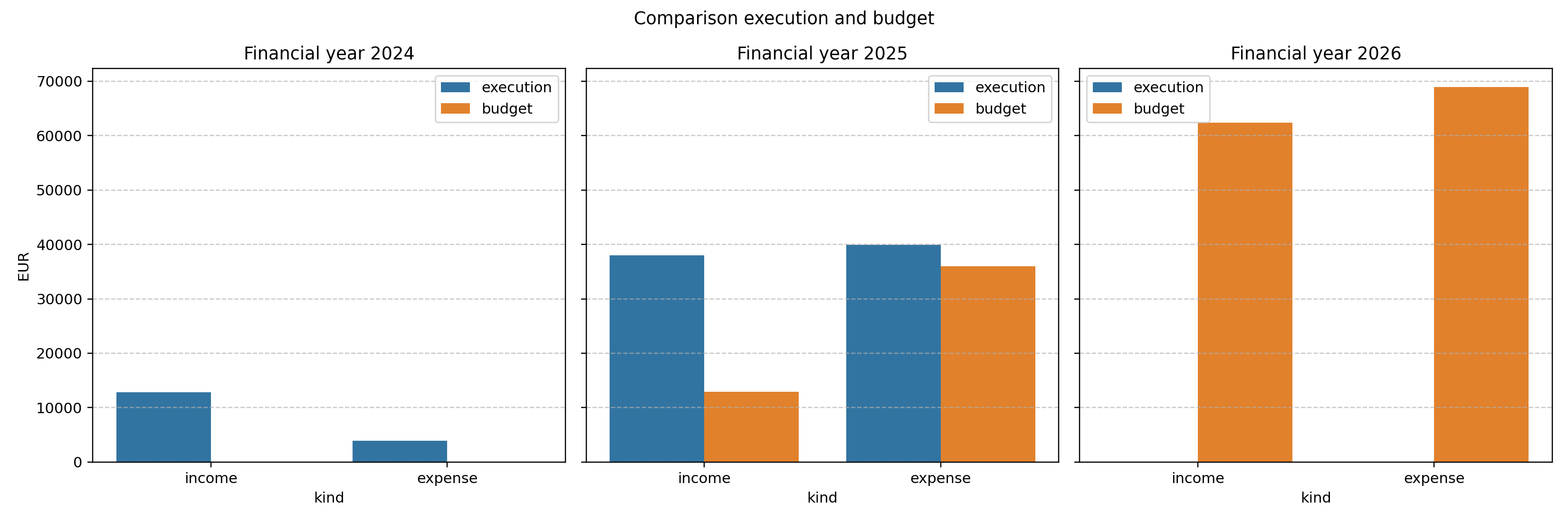
Finally, we would like to mention that we were unable to allocate additional budget for the CSP for 2026. Therefore, we will only be able to continue paying maintainers if the donations we receive are above what we budgeted, as the programme is basically funded from excess income. Luckily, we planned the programme with a 3 month buffer. In case funding dries out, it will only dry out by the end April, giving us a bit of margin.
Feedback and help welcome
As we grow our organization, making decisions, communicating, and staying in touch with the base becomes increasingly harder. We greatly welcome any feedback about the budget, the transparency or the communications we do in this respect.
We are also happy to get help and support from anybody intested in finances and communication. Please do not hesitate to get in touch by emailing us or reaching out on Mastodon. We want to give special thanks to Tom Lee-Gough, who stepped up and guided and supported us through the most complex parts of the accounting that we have presented here.
A huge thanks to everybody who is making this possible! ❤️ And see you in the next year's update!
If you appreciate the transparency of our finances and the work we are doing with postmarketOS, consider joining our OpenCollective!